

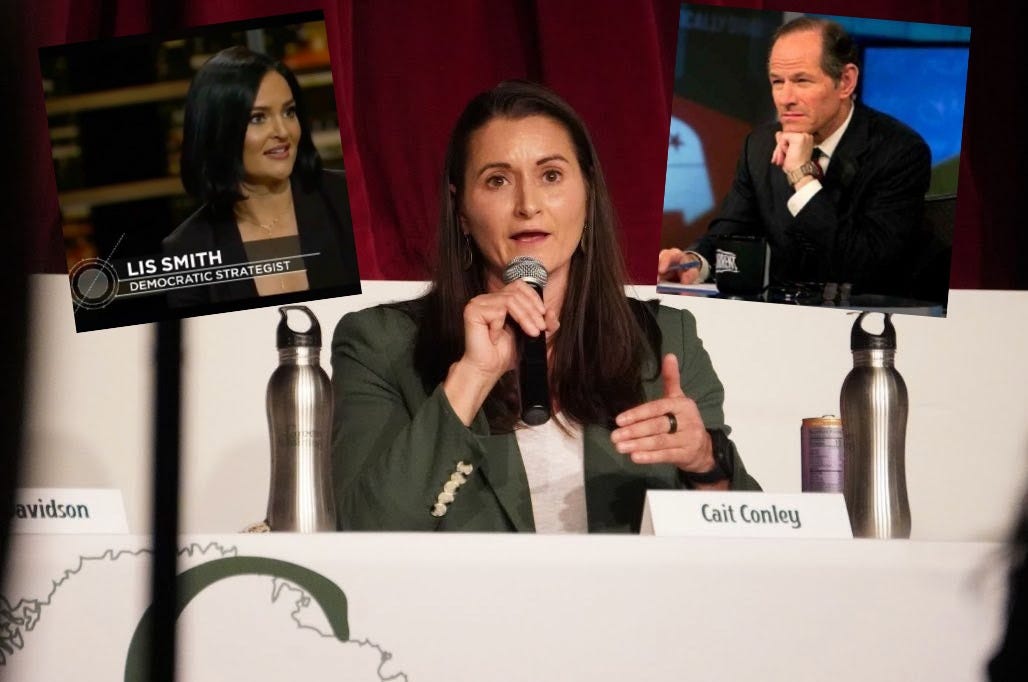
JUDGE ST — In the Spitzer household, when it comes to the Democratic primary in New York’s 17th congressional district, Cait Conley’s campaign is a family affair.
Scandalized former New York Governor Eliot Spitzer may have resigned in disgrace in 2008 after he got caught paying $4,300 to sleep with a woman just a few years older than his daughter.
But that never meant he was out of politics.
This cycle, Spitzer has involved himself in one of the most consequential congressional races in the country—the one to represent that curious strip of land an hour north of the city that has eluded his party the last two cycles. He made a maximum contribution of $7,000 to Conley’s campaign on May 15, 2025, according to Federal Election Commission records. He then followed that up by hosting a fundraiser for Conley, and soon after, his daughters donated their own money to the special operations veteran.
While Spitzer lives in Manhattan and gave money to Mondaire Jones last cycle, he appears to have a special connection to Conley’s campaign that stems from his romantic misadventures and runs through mysterious dark money groups exploiting campaign finance laws to support her bid for Congress this cycle.
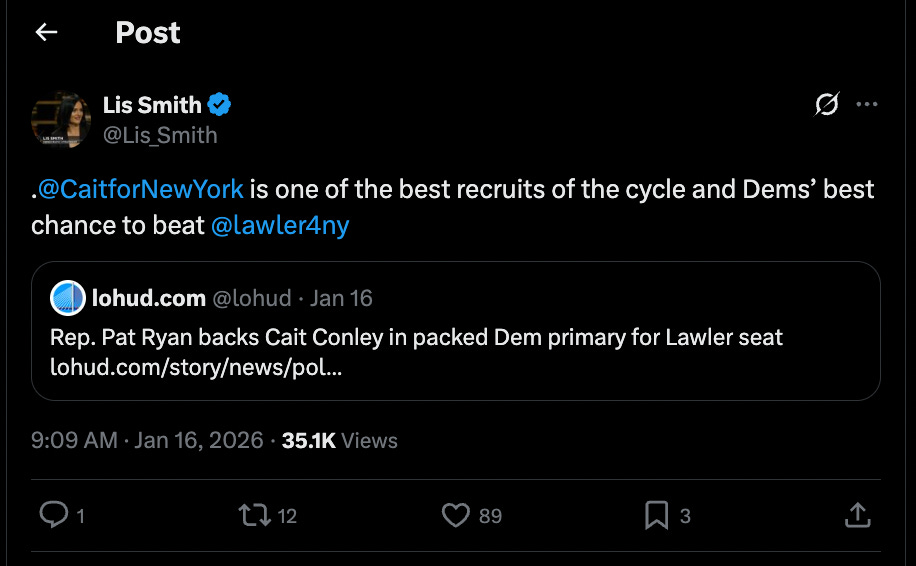
Veteran political operative Lis Smith, who once partook in a very public relationship with the married former governor, is also quite excited about Conley’s campaign. Smith called her “one of the best recruits of the cycle” and the party’s “best chance” to beat Republican Mike Lawler.
Smith is a storied political operative who works for three separate groups—Precinct, Majority Democrats, and The Bench—and they’re all supporting Conley in some capacity.
The trio has raised millions of dollars from Democratic megadonors with the promise of electing blue-chip candidates in some of the party’s most competitive races. For months, operatives and reporters wondered about the connection between the three groups that seemed to share both staff and financial causes.
Their efforts to skirt campaign finance laws were comprehensively detailed last month in a bombshell report from The Lever. The outlet’s findings hinged on a trove of financial transactions between the groups analyzed alongside communications between a Conley strategist and a reporter for the Judge Street Journal. Put together, they reveal an intricate web of cashflow from the party’s deepest pockets to some of its highest profile races—from the House race NY-17 to Senate races like James Talarico’s in Texas and Mallory McMorrow’s in Michigan—through the vehicles of The Bench, Precinct, and Majority Democrats.
In 2024, the FEC “expanded the power of joint fundraising committees by allowing super PACs and campaign committees to jointly fundraise together,” The Lever reported. The result: Groups like the Majority Democrats have started to raise and funnel as much money as they please to their endorsed candidates. Conley’s bid in NY-17 will serve as a test, and if successful, a model for electoral finance strategies going forward.
A voter can only give Conley $7,000, but anyone interested in getting her more money can give Majority Democrats or The Bench as much as they want, and the organizations can then use that money to help Conley without restrictions.
On top of this new arrangement, groups like The Bench appear to be providing campaigns with operatives who do work without drawing salaries from the candidates. PAC operatives are not allowed to coordinate with campaigns.
In NY-17, a Majority Democrats operative identified herself in an introduction text message to a Journal reporter as being “with the Conley campaign.” In the weeks afterward, she provided comments for two stories on the campaign’s behalf.
On September 29, 2025, the Majority Democrats PAC gave $90,900 to Conley’s campaign.
Shortly after, Smith’s ex-boyfriend hosted his fundraiser on behalf of Conley’s campaign.
“An invitation to the Pine Plains fundraiser obtained by Playbook touts contribution levels up to $7,000 for the Saturday evening affair hosted by Spitzer and his wife at their home,” Politico reported at the time.
After the event, Spitzer’s eldest daughter, Elyssa, gave Conley $1,000, and Jenna, his youngest, gave her $2,500. Sarabeth Spitzer, the middle child, came through at the very end of 2025 with her own $2,000.
Conley has refused to say how much money she raised from that fundraiser. The invitation told donors they would have the chance to “join her” at the event, according to Politico.
‘He was licking her toes.’ Who is Liz Smith?
Smith is one of the most experienced and controversial operatives in the election game. Combine her savvy and gumption with the deep pockets of Democratic mega donors, and it’s a juggernaut of a political apparatus.
Spitzer, who spent up to $80,000 on prostitutes according to investigators in 2008, first hired Smith to serve as spokeswoman on his redemption campaign for New York City Comptroller in 2013.
The “hiring by Spitzer came at the same time sources revealed to The Post that his wife, Silda, wanted a divorce and while he was angrily dodging questions about a rumored new mistress,” says one contemporaneous article from the Tabloid of Record.
Their relationship became red meat for paparazzi as 2013 wound down. It pushed incoming Mayor Bill de Blasio to renege on her forthcoming role at City Hall just days before he was sworn-in

Freshly out of a job, Smith tried laying low with Spitzer at a resort in Jamaica, but to no avail.
A 10-year-old vacationer spotted the couple and alerted his parents.
“Mom there’s an old guy in the Jacuzzi with this girl and she’s topless and she’s got her legs wrapped around him,” the boy apparently said.
Spitzer and Smith had been spotted allegedly making out in a public hot tub in front of families with children, and according to eyewitnesses, the former Governor appeared to have a proclivity for the podiatric.
“He was licking her toes,” the witness reportedly said. “She would sit in his lap. Then he’d put her feet in his mouth. He licked her toes and was playing with her feet.”
Smith later disputed the Post’s account of events in her memoir. She did not respond to a request for comment. Neither did Conley’s campaign.
The following month, to celebrate Spitzer’s divorce from his wife of 26 years, the couple booked a getaway to Vail, Colorado. They broke up two years later—after Spitzer told Smith he was being extorted by a Russian prostitute.
Smith began working with Andrew Cuomo on his 2018 gubernatorial campaign as an advisor, and she later helped his team’s efforts to discredit women who had accused him of sexual misconduct. She reportedly used her rolodex to get high-profile media faces like Chuck Todd and George Stephanopoulos on the phone to massage the narrative about her boss.
“I’m texting w Katy Tur,” Smith said in a work group chat, referring to the MSNBC host. “Katy is saying my spin live. Like verbatim.”
In her time working with Cuomo, Smith also mocked and denigrated the first woman to accuse Brett Kavanaugh of sexual assault in the lead-up to his Supreme Court appointment, according to text messages revealed as part of the Attorney General’s probe into her boss.
“Christine Blasey Ford was looney tunes and the height of me too overreach so this checks out,” she said in reference to one of Cuomo’s accusers retaining a lawyer who worked for Blasey Ford.
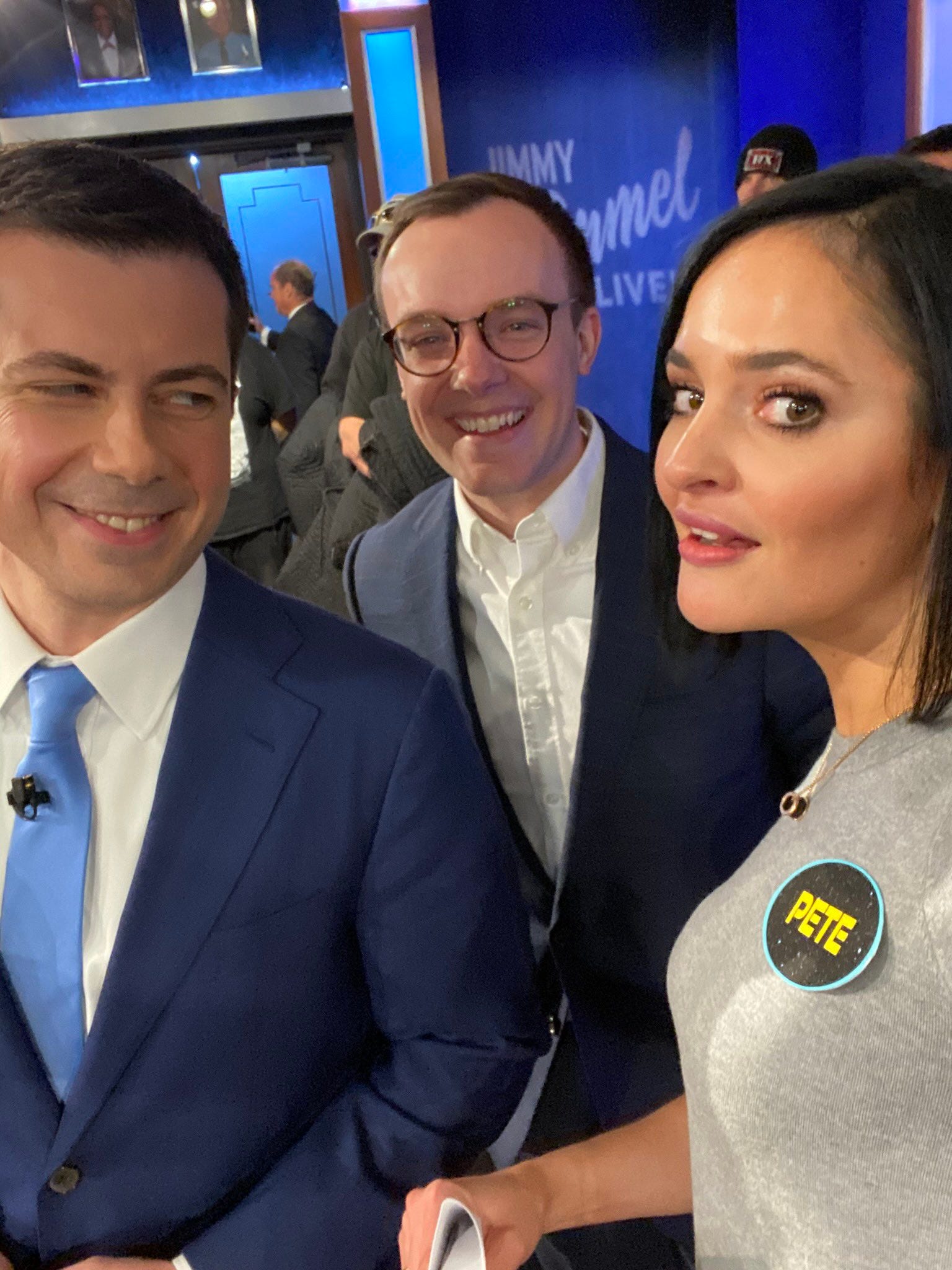
Smith also advised Pete Buttigieg’s presidential campaign in 2020. She followed that with a dishy memoir recounting all of her adventures with problematic men, and some suspected it to be a cynical attempt at reputation rehab.
“Say what you will about Andrew Cuomo, but he died as he lived: with zero regard for the people around him and the impact his actions would have on them,” she wrote in 2022.
In 2024, the Democratic National Committee hired Smith to lead efforts to defend against threats that might come from third-party presidential candidates, like Robert F. Kennedy Jr.
An accidental revelation
Smith began working for Majority Democrats in 2025—the same year it was started by venture capitalist Seth London, who also founded the Bench and signed the paperwork to incorporate Precinct as an LLC.
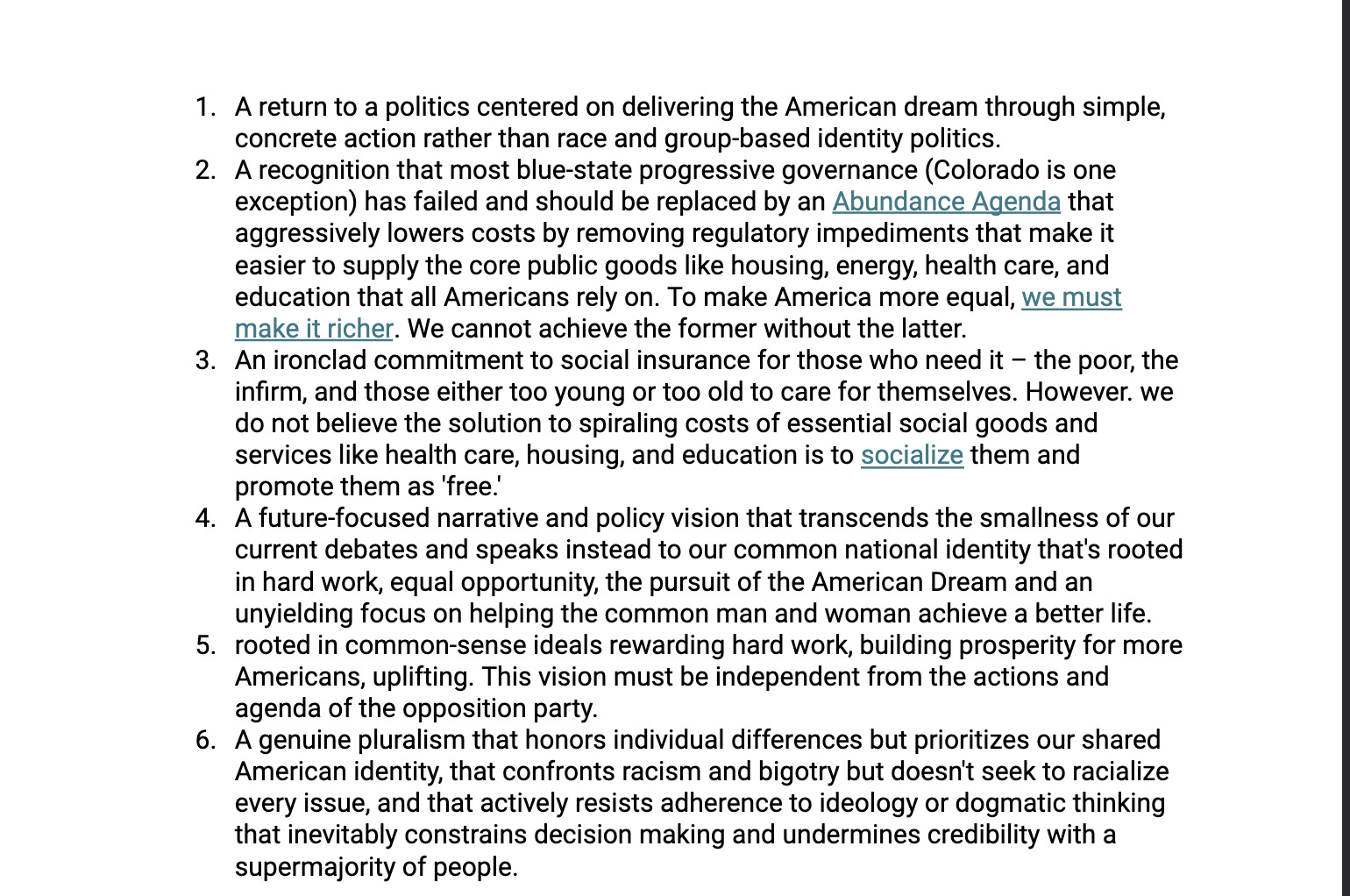
London’s idea was to create a “party within a party”—an arrangement of “fighters” who are “defined by an alternative vision for how to win and how to govern” animated by a set of beliefs he described as “Common Sense Democrats”.” He wrote a list of six ideas to unite all of the candidates.
Some of them bear striking resemblances to Conley’s campaign language. Number four, for example, calls for “future-focused narrative and policy vision that transcends the smallness of our current debates and speaks instead to our common national identity… .”
Majority Democrats registered as a hybrid PAC: An organizational model that allows it to maintain one fund with traditional PAC restrictions and another fund that can spend money with the freedom of a Super PAC—allowing Majority Democrats to move large sums to campaigns without revealing donors’ identities.
The most prominent public-facing donors associated with the organization is Stephen Mandel, who both maxed out his personal contribution to Conley in June 2025, along with his wife. Mandel has allocated more than $7 million to Majority Democrats’ PAC in the last year, according to CBS. To date, the PAC has given Conley more than $130,000.
Majority Democrats’ partner, The Bench, which also benefits from Mandel’s generosity, gave Conley $3,500 in December 2025.
“Personnel overlap between the two committees makes it hard to determine who is being paid by whom,” CBS reported in April, adding “that some of the same consultants who have been identified in news reports as working on behalf of Majority Democrats have also been quoted in the press as being affiliated with The Bench.”
The consultants also perform campaign work without receiving salaries from the candidates in return.
Jackie Rosa, a strategist listed as a Majority Democrats employee in a 2025 New York Times article announcing the venture, began communicating with the Judge Street Journal on behalf of the Conley campaign at the start of 2026.
“Hi Timmy! I’m Jackie Rosa with Cait Conley’s team,” Rosa sent in a text message on January 14

.Rosa provided statements for two Journal stories—one about the dubiousness of Conley’s Ossining residential claims and another about her endorsement from Congressman Pat Ryan. Rosa also made a local town supervisor available to give a comment in defense of Conley for the Ossining story.
According to campaign finance records, though, Conley never directly paid Rosa for her services.
A few weeks later, Rosa pitched a Journal reporter a memo attacking Conley’s closest competitor, Beth Davidson, for her work with milquetoast liberal groups like EMILY’s List and the New York State Nurses Association. But, she did not seek his consent to receive the document without attribution, so the Journal published the story on the record.
Rosa then tried to distance herself from Conley, telling the Journal that she was not acting on behalf of the campaign when she sent the memo. The signature in Rosa’s two emails to the Journal listed her position as “Communications Strategist, Majority Democrats.” But the email account itself is registered to the third organization, Precinct.
Rosa then told the Journal that the dossier originated from The Bench, instead of Conley’s campaign, but she did not provide any evidence.
The digital forensics of the dossier indicate that it was created by Matt Poms, an employee of Spiros Consulting, which Conley paid $36,650 in November 2025 for “research,” according to campaign finance records.
The political class initially understood the story as a cautious reminder to always seek a reporter’s permission before sending anything sensitive. It seemed like an embarrassing moment for Conley that would eventually pass, but it ended up revealing the connections between The Bench, Majority Democrats, and Precinct.
Rosa’s email and claim about the memo’s origin provided the first real-world link between all three groups. Operatives and reporters had previously struggled to establish connections using solely financial transactions, and this communication was undeniable proof. The Lever then used that information as part of a massive investigation into the shadowy network of donors taking advantage of campaign finance regulations.
With these three groups in her corner, Conley has access to levels of spending that none of her competitors can even glance at.
Conley is endorsed by End Citizens United, but she doesn’t have an issue with the dark money that’s lined up behind her. When it comes up, she says that she needs to “fight fire with fire” if she’s going to defeat Mike Lawler in November.
More recently, it appears Mandel and his wife may be using a fourth group, Vote Vets PAC, to support Conley.
On March 27, 2026, the couple gave Vote Vets $300,000. That same day, former NY-17 candidate Jessica Reinmann, who endorsed Conley, gave Vote Vets $25,000 from her shuttered congressional campaign fund. In May, The Bench then gave $400,000 of their own to Vote Vets, the Mandels tacked on an additional $100,000, and Reinmann topped it off with $12,000 more.
And in the final weeks of the election, Vote Vets is spending massively on Conley. By primary day on June 23rd, they’re slated for more than $1 million in NY-17 ad-buys.
Conley has distracted voters from the big money by embracing her working-class identity and posturing as an outsider. With a lengthy resume in public service and a communication strategist as sharp as Smith, many voters are convinced that Conley has the only shot at defeating Mike Lawler.
Even Spitzer’s ex-wife, Silda — more than a decade after their divorce —gave Conley $1,000 last Fall.
/////
Author’s note: If you enjoyed this article and would like to make it easier for me to dedicate time to reporting on NY-17, consider signing up for a paid subscription.
Interesting reporting. Thank you for something not superficial.