

An Interview with Cait Conley

After 16 years serving the country in the Army, Cait Conley moved to NY-17, announced her campaign in the Democratic primary, and quickly became one of the establishment’s favorite horses.
With working-class roots and a long resume of public service, Conley offers Democrats the chance to replicate their success just one district north with Congressman Pat Ryan. She presents herself as a fighter, eager to take on the system that’s failing people in the Hudson Valley. Ryan endorsed her in January.
She also has support from prominent groups like Gabby Giffords’ PAC, Equality PAC, Majority Democrats, Democratic Majority for Israel, and Vote Vets. The Democratic Congressional Campaign Committee has been eyeing her from the start, and she was one of just two candidates in the crowded primary to score an invite to their Candidates Week. The other was her closest opponent, Rockland County legislator Beth Davidson.
This morning, Conley got two pieces of good news: Vote Vets released a poll that showed her in first place with 29% of the vote—7 points ahead of Davidson, with 38% still undecided. On top of that, she received an endorsement from the chair of the Westchester County Democratic Committee, Suzanne Berger. The organization itself declined to endorse any candidate in the race last month.
Conley sat down with the Judge Street Journal at Here Coffee + Beer in Ossining on May 19. The following transcript has been edited for length and clarity.
So the first question I like to ask everyone is to describe the district and how you’re thinking about it.
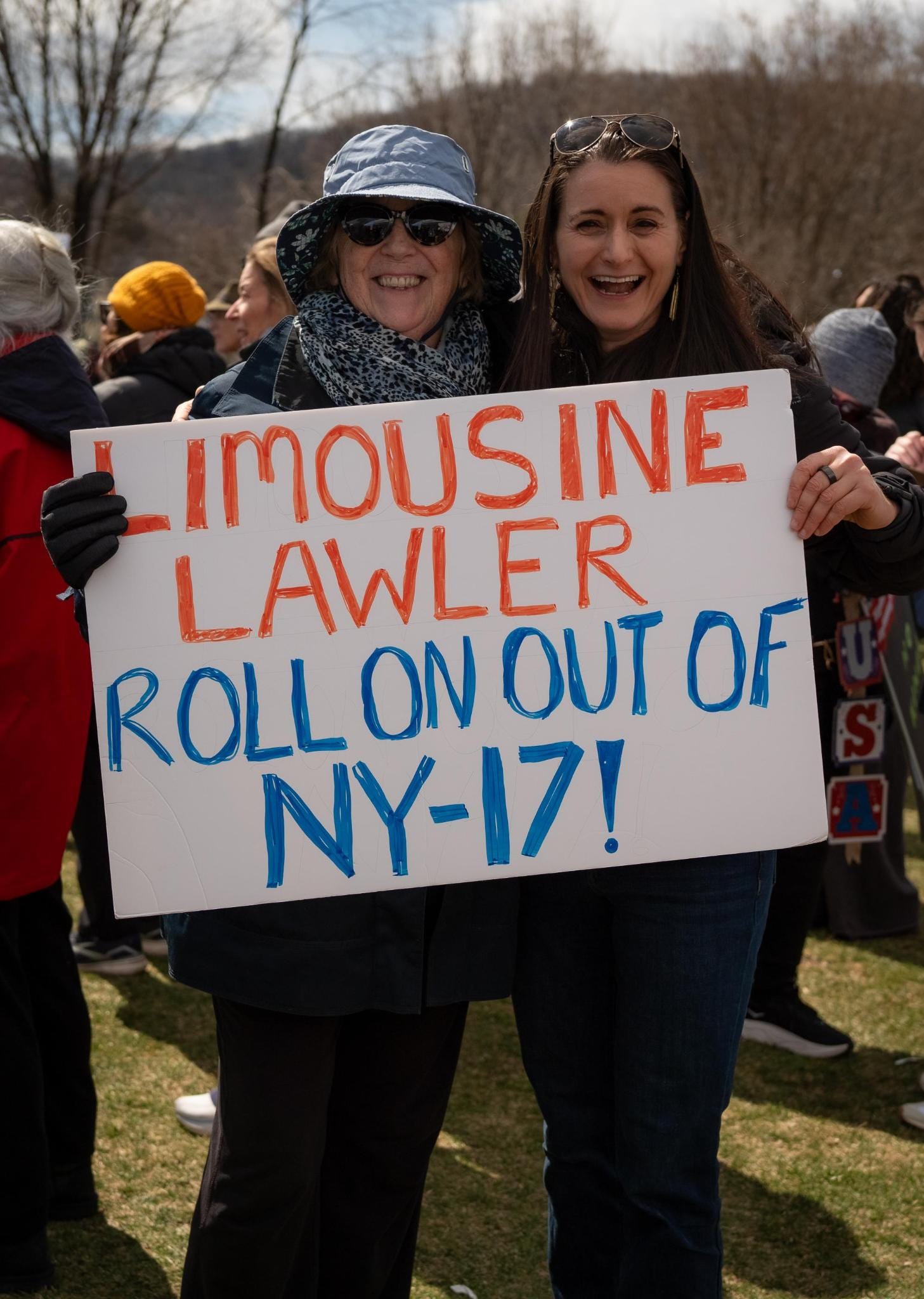
So I do not like to quote Mike Lawler often, but I do appreciate quoting him here, because I think we do see the district similarly. He calls it the district of heroes, and he talks about how over 50% of households are either service members, veterans, law enforcement, or first responders, and that is a big part of who we are, right? Service in this district matters. You grew up here, you know, after 9/11, the impact that it had on the Hudson Valley, on this city, how many folks were lost who worked there or were first responders.
But also, just like this sense of collective responsibility. I talk about my godmother, right? It was like my second mom. She started Fred Cook Septic with my uncle Fred 50 years ago, over in Montrose. She has been with the Montrose Ladies Auxiliary for 64 years. Every guy, my grandfather, my uncles, everybody was part of the Portland fire engine, like this volunteer sense of service. We owe it to one another, and I think that is a really important part of who this district is.
It’s a place where there’s a lot of pride in your town, in your community, in our country, and that thread is a pretty beautiful thread, because it’s not even just in the traditional public service, like the first responders or military service. It’s in the number of nonprofit groups and community organizations that are out there taking care of our neighbors and members of our community, and so I do believe this is a place where service matters, and you see that in so many ways.
And then, building off that, is there any way you’re thinking about approaching one part of the district with one strategy and then another part of it with another, or do you see it as unified?
When you talk to folks, I think it’s important to understand where they’re coming from and what they are feeling and what matters the most to them. I will say, while it’s like this catchphrase—”affordability”—it is at the forefront of everyone’s minds, even if the person I’m engaging or talking to is well-off and financially solid.
They’re worried about their kids, their grandkids. How the fact that we are in an affordability crisis is literally driving people’s decisions to vote and who they trust and where we’re going, and so the affordability issue is certainly something we see playing out in everything, and it didn’t just start with the Trump administration, right?
Like, these are issues that you’ve seen people struggle with for years, and it has been exacerbated over the last two years, and I mean, this is also an important part of how Trump got elected, right? And why it was so close here in this district—how 49% of it voted for Trump. I met a lot of these voters, and I have to tell you the most heartbreaking part of hearing why so many voted for him. They didn’t like him. It’s because in his lies they heard hope that here is this guy who was going to take a sledgehammer to a system that no longer works for working people, and I think that there is also the underlying current of “people feel like the system is broken.” It’s corrupt, people work hard, but they’re not getting a fair shake, and that sentiment is really so important to so many folks, too, and I think how you see it being expressed at the ballot box.
So in that way, yeah, affordability is everywhere, but people are also concerned about the direction of this country and democracy, and whether or not our institutions are going to be able to withstand four years under this administration.
What do you think went wrong in the last two cycles for Democrats? How are you thinking about it differently?
Here in 17?
Yeah.
I think 17 is also a good example of where we’re losing the country—where understanding who people are, who voters are as people, and the fact that they are struggling, the fact that families are working full-time jobs and still struggling to put food on the table and a roof over their heads, right, and pay the electric bill, and are truly having to make trade-offs between prescriptions and groceries, like these are real things.
And the fact that, as Democrats, we, too, haven’t met the needs of people to deliver and make their lives better. Now, a lot of people keep putting things on Trump. I’m like, “Assume some responsibility, folks,” because you know what? The Democratic Party, we allowed him to get elected twice, and so I think a lot of this is understanding where, as a party, we have fallen short. I think that includes here, right? You know, there’s a saying in the army, “the fastest way to lose the current war is to fight the last one.” When I was growing up, New York 17 was in the Bronx. Every 10 years, we do a census, we redraw lines. 2011 to 2020: New York 17 was bright blue. Joe Biden wins by double digits. We have a Democratic representative for decades. 2021: They redraw the lines. Now it goes from really two counties to four, right? Moves north, and with it, the demographics of the district fundamentally change. You now have a truly purple district where 20% of registered voters are unaffiliated or independent. You can’t win this district by just appealing to Democratic voters alone. You need to be able to appeal to the voter as a person, not just a party. And I think we’ve been running the wrong strategy. We’ve been fighting the old war, not the current one. We’ve been fighting for the old New York 17, not today’s.
Does that mean too progressive? What do you mean by the old strategy?
I think it was focusing on just being against something, right, being like anti-Trump, being anti-Republican, versus saying I am for a better America, right? Like, truly, what are you fighting for? Because that’s what’s going to unify people. Even now, when I go out, we do events, and even though it’s a Democratic primary, and we’re just trying to really reach Democratic primary voters, we’ll have folks who are independents and Republicans come to our events too.
I had a guy—so we’re at one of my Pints and Patriots events, where we rent out a bar, we buy the first round, have folks come in. I talk like five or 10 minutes, and we just mingle. I had a guy come up to me at one, we did over in New City, Burger Loft, and he introduced himself. He was like, “Hi, I’m a MAGA Republican.” I’m like, “Cool, like I’m Conley, proud American, like let’s talk, man.”
And to me, we talked, right after about five minutes at the end of it, he says, “You are the type of American I would follow, you have my support.” And that’s the thing, where it’s like, look, when you look past the labels, and you just talk to people like real people, you’d be amazed how powerful that is, but I think we’ve gotten sucked into partisanship, and again, that worked in the old New York 17, but it doesn’t work in this one.
That block of independent voters that you’re talking about—are you thinking that they’re automatically the right of Democrats, necessarily? Or is it possible that maybe some of them are like disillusioned with the Democrats from the other end of the spectrum?
I think it goes back to the question before, too. I really believe the labeling is what is making all of it worse, right? So, going back to how do I talk to folks—I really try to say, I am a person who is focused on solving problems, right? And when you talk about “What are the values?” framing it in ways where these aren’t just partisan values, right, they’re American values.
I talk about fighting for freedom, justice, and equality for all. That’s why I put on the uniform, man. And when I talk about why I’m compelled to do this, it’s because those values are at risk. We didn’t fight overseas to defend American freedom to just watch our own government trying to take those freedoms back from people right here in America.
And so I think the way we learn and approach people is by focusing on what we share, because we share so many values, so many more so than we don’t, or that divide us. So it’s really focusing on—everybody wants to be able to feed their family, everybody wants to be able to put a roof over their heads, everybody wants to believe that the American dream is real.
Those are powerful dreams, and they’re not one side or the other. I’ll tell you, because I think this is another misperception, too, you know, going back to my point about why certain folks voted for Trump. There are a lot of folks that I met who voted for Donald Trump, who share our values, who believe in democracy, who believe in American institutions, who believe the rule of law applies to all, who believe that people should have access to health, right? They just didn’t have the luxury of voting on that, because they didn’t know how they were going to pay their electric bills.
And so I think some of this goes back to understanding that the way Democrats win here in New York 17, I think nationally there’s lessons to be learned from us, by understanding where people are having problems, understanding the role of government to try to solve those problems, then actually delivering, because there’s so much power in that.
What do you think the ratio needs to be between hitting Trump and Lawler versus offering an affirmative set of politics?
You’ve got to be telling the whole story, which is both, right? It has to be showing Mike Lawler is going to tell you that he’s actually solving your problem, but you know he’s not. And the question that I ask Mike Lawler voters, like, “since he’s been elected in November of 2022, is it any easier to put food on the table or roof over your heads, keep the lights on, afford health care, or give your kids a better future?” And you see them struggle, right? The answer is no, and I’m like, you deserve better.
And that’s where we are starting to see the pain already, right? You talk about the impact on the Medicaid cuts here in the district—37,000 people losing access to healthcare. You talk about the impact on medical systems already that are under strain, just in Northern Westchester. We’re going to lose over $100 million in revenue, you know. We talk about things like SNAP programming, they ripped $20 million away from SNAP benefits, just in Rockland County.
The energy crisis: Every one of our energy providers, Con Ed, [New York State Electric & Gas], Central Hudson, all of them are seeking double-digit rate increases, right? At a time where people are already struggling to pay their bills. So we should be investing in programs that help people get to greater energy autonomy, have more solar at their homes, have more geothermal, expand the grid in energy development to things like the offshore wind project in Long Island, but instead of doing those things, the federal government clawed back rebates, clawed back grant money, and is now going to pay a French company almost a billion dollars to stop a project instead of completing it—a project that would provide energy to like what, 1.2 million homes to include some here in the lower Hudson. And so I do think part of this is shooting people straight and saying this is the stuff they’re doing and why your life isn’t getting better.
Naming the enemy, as they say.
And the impact, right? Like, actually pointing to: What did they do? How are you feeling it? But then the second part has got to be we understand that you also need hope and belief that things are going to get better, and that goes back to what you’re fighting, and I really believe Democrats have to do a better job of providing tangible things that we can do, and I think also accepting that we’ve got to find a way to deliver, even when Trump is still sitting in the Oval Office, you know. We can’t say that for 10 years, we’re just going to be the anti-Trump.
What is the plan if the Democrats get a majority? What are some things that you’d like to do in your House seat to check Trump?
So I think there’s checking Trump, and there’s also solving other problems, right? I do believe that congressional oversight mechanisms are effective when they’re released. I’ve been on the other side of it, right? When I was at CISA, I briefed congressional committees, I was part of congressional oversight on the receiving end. How are we executing funds? How are we achieving the missions that they’ve articulated? It is an effective tool when it’s actually used, because there are consequences when there are abuses of power, right? And this whole tone and tenor, right now, where cabinet officials are above the rule of law, that’s bullshit. Same thing with people in federal government service, they’re not. And so I do believe there needs to be investigations and accountability into the weaponization of the executive branch that we are seeing, and those folks need to be held accountable.
Who do you want to see do these investigations?
I think at this point, because you’re still going to have Trump controlling the executive branch, I don’t trust the executive branch to do it themselves. I mean, they’ve gutted the inspector general programs, right, like a third-party apolitical entity that you should be able to trust to do that. And so I do believe this is going to be Congress’s role—where House Judiciary Committee should be looking into the weaponization of DOJ and FBI; how we should be looking at some of Energy and Commerce, the business deals that are going on that are incentivizing Trump loyalists, often at the expense of America and American businesses?
I mean, what we just saw, where Trump went after Anthropic because they refused to comply with some of the DOD’s demands, like you’re trying to now say that there are national security risks. That’s not America, that’s not a free market. And so I do believe there are things like that, congressional committees are uniquely postured to do effectively, especially right now, where we cannot cause the executive branch to regulate itself. But we got to get back to a point where it does. This can’t be the norm. We can’t have Kristi Noem and Pam Bondi and Pete Hegseth be the norm of what cabinet officials are going to be. I think that’s really scary.

Pivoting back to affordability and rate hikes, is there a specific policy you’re looking to implement?
The thing I am very, very passionate about is creating a public service home loan program. So, for veterans, we have something called the VA loan program, where, after a certain number of years of service, you qualify for the VA loan. What’s important to understand is this isn’t a handout; no one’s just giving you cash. It is a program where the Department of Veterans Affairs guarantees 25% of your mortgage to a private lender that allows Chase, USAA, or Wells Fargo, whatever, name your bank, to give you a competitive interest rate on a mortgage without you putting 20% down and without you having to pay PMI, private mortgage insurance, every month.
It removes the barrier of having to have wealth to get a mortgage, and when we’re talking about the struggle we see right now, where we don’t have enough nurses, enough teachers, enough first responders, this type of program, where we’re investing in the people who are investing in our communities, is a game-changer. We’re not saving enough, that 20% to put down on a house, and this goes back to where we’re failing as a country. When you have people serving a community that can’t afford to live in the community, things aren’t working, and so an American public service home loan program, or if you’re a teacher, a first responder, or a nurse, after a decade of service, you qualify for the same benefits. It’s not a handout. No one’s giving you cash. The cost of administering the program is handled by the person taking out the mortgage with a funding fee, and it helps people get a hold, so they can start investing in themselves, right?
How’s fundraising? This is like one of the most expensive districts in the country to run in.
It is brutal. It is brutal.
It’s the first time you’ve run for office, so it’s the first time you’ve had to deal with this stuff.
And I’m not a multi-millionaire who can cut a six-or-seven-figure check. It has been pretty eye-opening to be very candid—how much this system is really designed for people who come from either a wealthy or politically-connected family. I am neither, but I’ve worked my ass off over the last year. I think the fun part has been asking for more help than I’ve ever asked for before, but like inspiring people along the way to believe—that has been motivating. And I’m very clear-eyed that Mike Lawler is one of the best Republican fundraisers at the congressional level out there. If we’re going to beat him, we need somebody who can fight fire with fire and who can help bring resources to make sure we’re not outgunned.
What does that mean?
There’s going to be what, 30 competitive House races out there this year? Getting people to understand the New York 17, it is a fight for us here, right? It’s a fight for the Hudson Valley, it’s a fight for New York, but it could also be the decisive seat in whether or not we take back the House. So it’s also a fight for this country, and when you look at Mike Lawler’s fundraising numbers, almost 70% of his funds come from out of state, right? Like he has built up a national network of support. I think we’ve got to be very clear-eyed about, like, he is going to be hard to beat in November, very hard. And so we’re going to have to build up our own support to take him on effectively.
And so that’s a very long answer to your question of, I think fundraising is going well, right? I’m very proud that we’ve raised over $3 million from over 20,000 different donations, like our average donation—90% of our donations are under $100, and we’ve been able to really build just an awesome network of support and people who are mobilized.
We saw that play out in petitioning, where we ended up getting petition signatures to get on the ballot from every town and city in the district, and I think the support we’ve seen with fundraising has also translated to endorsements, right? I’m the only one in this race that’s been endorsed by current elected officials in all four counties, and we’ve been able to get over 60 endorsements from current and former elected officials, committees, committee chairs, leaders, and so, yeah, not too bad for a kid who grew up in a working-class family.

You talk about the frustration voters have with the system, but then there’s also the reality that Lawler is going to have a bunch of money. It seems like you’re willing to take money from larger groups, and voters may think of those larger groups as negative. Are they going to project those negative opinions onto your campaign and assume you’re backed by larger big money?
Yeah, a lot of the conversations I have about this is like, when people think of Citizens United, and we need to end it, that is the soft money side, right? When you talk about how much money I raise, that’s hard side campaign dollars, that is very regulated. The most any individual can give me is $7,000. The most any political action committee can give me is $10,000.
Right, yeah, they could also spend it on your behalf too, right?
Right, well, you’re talking fundraising.
Yeah.
Okay, so what I will say then is also like the groups that have supported me and cut those checks. It’s Giffords PAC, right? Like Gabby Giffords. We’re talking about [Natural Resources Defense Council] Action Fund, an environmental group, like about things we care about. These are groups whose issues I’m also proud to stand behind.
Now, I would say, we talk about “How do we fix a system to have people build trust in it?” I have been incredibly vocal about the need to end Citizens United and get money out. I am very happy to lead the charge to end what I believe is hurting American democracy. I do. I think the money in politics, and what we’ve seen, where groups are literally trying to buy our government, our democracy, is one of the worst things that’s ever happened to American democracy. I think that, and social media, in some ways, with no regulation, and disinformation operations that are getting fueled by our foreign adversaries.
So, I’m very proud to have been endorsed by End Citizens United to call for reforms. I’m all about banning stock trades, implementing congressional term limits, ending Citizens United. Those are important things. I feel like we have to get done, and I do believe there’s a generation of us coming up where, we’ve seen politics in America go off the rails over the last 15 years, and we’re like, this can’t be what continues, and the Citizens United Supreme Court case ruling, and the timing of things going up off the rails has aligned pretty nicely, right? And so it’s like, we’ve got to fix what is going on, and I do believe that is a big part here. And so I’m just trying to get out there today, so voters know who I am, and like what I do want to fight for.
Do you think there’s a contradiction at all between being endorsed by End Citizens United and having a Red Box on your website to ask for groups to buy ads for you, or do you think abstaining would be like shooting yourself in the foot against Mike Lawler?
We know that he is going to get dark money because he already has, right? Elon Musk—$1.7 million. We need to fight fire with fire.
What did you make of the new Data for Progress poll? How are you thinking about it?
I don’t know if I know the one you’re talking about.
From a few weeks ago, the one that Effie Phillips-Staley paid for. It had Beth in first and then her in third, and you in second, and it also polled Zohran’s popularity and found him pretty popular.
I’m really just focused on kind of running our campaign, which is focusing on getting in front of as many voters as possible, and I think the poll, or the results that I care about, is June 23.
Gotcha.
And I mean, look, I do think I’m not an elected official, right? Like, I don’t come from a wealthy family. This has been like an upward hill for me to climb in order to be able to get out there, but I’ve been really proud of us working our butts off over the last year, trying to get in front of as many people as possible, and we’re just going to sprint through the tape on June 23, and so I’m kind of ignoring the noise and really just focusing on: at the end of the day, it’s reaching the voter and just trying to get them to hear your story, like that’s what it’s about.
I think that the other part is: Voters are going to make their decision when they walk in to cast their vote, right? I’m about to go vote in the Ossining school board. When voters walk in, all you see is a name on a piece of paper. There’s no bio, there’s no photo, it’s just a name. And so, what do they feel when they see that name? Do they know your story? Do they know who you are? Do they know what you stand for? I think that’s the really important part—trying to get out there as much as possible.
There was a moment in the Westchester County Democratic Committee’s debate a few weeks ago, where you and Beth had a little back and forth, and she said there’s nothing Lawler would like better than to run against a former Biden official, and you noted that she’s been working in politics for her whole career, whereas you’ve been in public service. But how do you square being an outsider with having your insider experience? Like you know how sausage is made from your time working in Congress. Square that circle for me.
That’s a very good question. So, when I was at the White House as an army officer—getting to see and to be part of discussions around national security and what it’s going to take to keep our nations safe for the long term—and going to CISA and serving as a senior executive and working with members of Congress, I do believe that the experience of understanding what the federal government is and how it works, having also been part of it as an army officer well before the White House, right, and understanding the stakes, like when we talk about going to war, those are really serious decisions, when to use military force, and we have seen with this administration people who think it’s a game.
Having the experience of having been there, to know the stakes, to know the cause, I’ll tell you, those of us who’ve been there, it’s the last thing you ever want to see is any kids in any generation have to do. I think those experiences are incredibly valuable to make yourself the best representative possible, focused on delivering results, right? And I think there is a difference between having been in public service versus having been in political consulting, right? And when it comes to this district, I think that’s going to matter to people, especially people beyond just the Democratic voter base that we’re trying to win over.
And we’ve seen this nationally, right, where when you take a veteran Democrat versus a non-veteran Republican, we’ve seen a significant advantage to the veteran Democrat, right? It’s over a five-point advantage nationally, I think, is the poll that Vote Vets put out. I do think there is a difference between that. I also think some of it, though, is also just the frustration with the system, right?
The politicians, who for decades have created this dynamic, this hyper-partisanship, this dysfunction, I don’t believe they’re going to do anything different going forward, and that is where I believe there’s a generation of us coming up, where just like, I am literally inheriting a country and a world that is worse off than my parents did. That’s wrong, and we’ve got to break the cycle, and so I think there’s also just an element of new blood, new perspective coming in to help also change the Democratic Party, and I think that’s important, because it’s going to play a very important role in getting this country back on track.
That’s interesting. I think Beth might be satisfied with that answer, but I think an Effie fan might hear that and say that’s fair, but you know, public service is a big category. And it can range from everything, from being in the infantry to doing high-level intel work that’s not super public. Someone could argue that you do know the system really well, you know, and that you’re not that much of an outsider. What would you say to them?
I think there’s a difference between being a political operative and a public servant.
Zooming out on what we’re really focused on, the mission, it’s beating Mike Lawler. And we’ve already seen him face two politicians before, and they were former members of Congress, right, and he beat them. If we want a different kind of outcome, I think it’s going to take a different kind of Democrat with different experience, an experience that can motivate people to believe we’re actually going to do something different.
On immigration, how do you see Congress playing a role? Because now immigration seems like an executive order thing with Trump back in office. You know what? What do you want to do there?
What we’ve seen this administration do with the weaponization of the executive branch is truly one of the most un-American and disgusting things I’ve ever seen. They are going after, not criminals and cartels, the members of our community to include people who are doing everything right, going through the actual immigration process, that’s not who we are as a community, and so I do believe we need to absolutely rein in the abuses at ICE and beyond, we were talking about earlier about the DOJ and FBI, how they’re investigating political opposition, like our own Attorney General, Letitia James, right. What we are seeing are abuses that we can’t allow to become normalized, and that is where I believe congressional investigations and oversight matters.
I do believe budget power matters. Authorizing funds and not, for certain things, matters. And that is a tool to be used. I think one of the other things that we have to also really talk about is how the system itself, our actual immigration system, is broken. It shouldn’t take people a decade to have an application process. We owe people better. There are people living in our communities who have been taxpaying, contributing members of our communities for literal decades, but we never gave a real pathway to citizenship for them. Dreamers.
So, what would be the criteria for citizenship?
I think it’s time-based, I think it’s conduct-based, and there’s ways we can do that. And again, part of what has made this so hard, too, is the system itself has never been invested in. When you talk about how so much of this takes so long, when you dig into the details of how these things are funded, right?
So, within DHS, you have CIS.
What’s CIS?
It’s Customs and Immigration Services. It’s the agency inside of DHS that actually runs the immigration side. Like, they process all of the immigration itself, so it’s that element in DHS that does the actual immigration services. Don’t quote me on exactly what it stands for, but it’s like that.
But they’re the ones who do like the immigration applications and investigations toward citizenship and getting people on pathways and managing that, but no one’s ever given them money to invest in updated and modernized systems, and they don’t really get it because they’re fee-funded, which means it’s people applying to go through the process that are paying for the agency to run.
And so I think a lot of this is also we owe it to modernize the system to help process it, like when you talk about people seeking asylum, that’s because they’re feeling a threat to their life, right? For that to take 10 years to adjudicate, you’re literally talking about someone’s life on the line. These are the types of things where it’s just like we can do a lot better, and so you know the other part of this, too—we’ve got to get a pathway to citizenship for people who have been here, the contributing members of our society, they’re our neighbors.
We’ve gotta protect the Dreamers, we gotta have a system that actually does this in a timely manner, so people aren’t living in limbo for years. And we can do that, like that’s the other thing I believe in America, we can still do hard things, we can fix this stuff.
Have you done any polling lately? Do you have any polls you want to break with the Judge Street Journal?
We don’t, but we will if we do.
You have lots of military experience, and oftentimes, the Israel conversation lacks the perspective of someone who’s actually been on the ground in a military situation. First, how do you think about the whole situation in Israel and Gaza?
I cannot state enough that when you have seen suffering from war, the last thing you want to see is more suffering, right? And when you look at the conflicts that continue in the Middle East, we have got to get to a point where there is a peaceful resolution, and we’re focusing on development, safety, and security for both sides. And I’ll tell you, in this district, when I talk to folks, the overwhelming majority agree with these principles, right? They don’t want people to suffer. They want people to have access to food, and safety, and security, and health care. They don’t want to see war.
And I do think that there are still very real threats that are out there, right? I have worked in the counterterrorism space, where the Israeli military, the Israeli intelligence services have literally helped save American lives and prevent terror attacks. And Israel is still the only democracy in the Middle East, and I do believe we have a responsibility to help ensure the safety and security of the Israeli people.
I think a big part of that, though, is getting to a two-state solution. I would love for us to be talking about, “How do we get in a third-party peacekeeping force that helps ensure compliance on both sides? How do we focus on reconstruction and rebuilding, right? How do we get that as the focal point and progress being made?”
Do you think Israel’s response to October 7 was proportionate? When you look at the horror of that day, and then what we’ve seen in the past two years, has that been proportionate?
I think just like I can be pro-American and criticize Trump, and just like when I was serving overseas, we saw people right here in America debate whether or not we should be at war, I can support the Israeli people and the State of Israel, and still criticize Netanyahu and some of the decisions being made by his administration. And at the end of the day, what we need to be focused on is, “How do we get to long-term peace and stability and safety and security for everybody in that region?”
Is that yes or no?
I don’t think it’s that simple.
When people say it’s gone too far, what goes through your mind when you hear that?
I think that after years of conflict, we are still not talking about, “How do we rebuild and ensure enduring peace?”
Yeah, well, I think people are focused on the trauma, though, right?
Well, that’s part of the rebuilding, right? Like giving people home and stability and security. And with that, we can’t let Hamas be part of the next government, right? Like, acknowledging the realities that it is still a terrorist organization, and part of what led to this, right?
Did you happen to see the Nick Kristof article from this past week in the Times that included Palestinian prisoners detailing their experience of sexual assault in Israeli custody, and apparently, Israel had trained dogs to rape prisoners?
No. None of that conduct by any force is ever okay. And so I can’t say I know any specifics or insights, but I will just say, period, that type of conduct is never acceptable. Again, like, I do have tremendous pride being an American military service member, where conduct matters, ethics matter, and people who violated those things were held legally accountable. That is what our values are, right?
I noticed you filed an extension on your personal financial disclosure. Your opponents have attacked you in the past for the work you’ve done for AI companies that partner with Palantir, and I wonder if voters would be disappointed to not see the personal financial disclosure. Does that maybe muddy transparency in some way?
I think they would be pretty underwhelmed with my personal financial disclosures compared to the rest of the field, where I think I’m a few figures removed from the wealth of others. But no, I’ve been very direct about the work that I have done and continue to do. And this is where I will be very clear that I have never and do not work for Palantir. The work that I’ve done that I am proud of, with the two companies I advise, it’s doing things like partnering with state and local law enforcement to make sure that when we go to a Yankees game or a concert, families don’t have to worry about getting hit with a terrorist attack.
I’m proud of that work, and for people to try to misrepresent it as it being something else is pretty sad. And I think this goes back to—what people don’t want right now are more political operatives trying to spin things and misrepresent things, and I think that is what they are sick of on both sides.
Wouldn’t it make it easy, though, if you just released it, and then there would be no speculation? What was the delay?
I’m busy trying to win a primary.
It seems like every other candidate’s been able to release it, though, right?
For this year?
Most candidates in an election are generally able to release it. It’s notable when a candidate files an extension this close to the primary.
We released last year’s on the same timeline.
So, why not this one? Like, is there anything new in that one?
We filed an extension last year, didn’t we?
Yeah, and it eventually came out. But I guess for voters who were looking for the new one before the primary, and maybe they’re disappointed, what do you say to them? Are there any new contracts in there?
No. It will be very similar to what my prior would be, and so no. My priority is focusing on getting engaged and meeting voters.
[Hours after this interview concluded, Conley filed her personal financial disclosure.]
Okay, last question, a fun question. You have to host three Democrats and one Republican in the district. Where are you going, and who are they?
So I would do FDR and Eleanor Roosevelt. I think they’re a fascinating couple. I think, talking about leading this country through some very trying times and coming up with innovative solutions and just approaches to, “How do we get this country on a solid foundation?”
People love Eleanor. You’re the second person who’s told me they’d pick her.
Have you seen, it was a Showtime series—
Oh, no, I haven’t.
First Ladies, I think, where she played a character in it. I never finished the series, but I have to tell you, such a powerhouse of a leader. For a woman to have that kind of role and voice and influence in that time, I mean.
Alright, so those two, I love Michelle Obama. Love her, she’s got great arms, brilliant, wonderful human. I’ve never met her. I would love to meet her. I truly think she’s just the best of America. I really do.
The Republican: John McCain. I think he is a man where I didn’t agree with every one of his policy positions, but the courage he demonstrated throughout his life, and truly his commitment to trying to do what was right for this country. I mean, there’s nothing more pure or beautiful than that, like he genuinely tried to do what was right, that included standing up to Trump and really going to bat, and he also tried to make sure politics wasn’t toxic, right? Like going back to when people attacked Obama, when they were running against each other, he didn’t lean into it; he fought it and said, “This is not what this is about. This is an incredible man,” and so I think that kind of decency and leadership is pretty awesome.
Where are you going? Where’s the dinner?
Does it have to be dinner?
Or lunch.
I’m a little obsessed with the Blue Pig in Croton.
I’ve heard you mention this place before.
I am obsessed. It is this little ice cream shop that uses all local ingredients. I’m not a big ice cream fan unless it is the Blue Pig, and so I will shamelessly promote this. They shut down for two months, January and February. I had at least a dozen pints in my freezer in the garage while they were closed, because it has been like my go-to. I love them.
I would say if we had to do real dinner, Terra Rustica in Briarcliff, like really good Italian and a quality carb-up for a long fight ahead.
///////
Editor’s note: If you think that local journalism matters in NY-17, consider upgrading to a paid subscription. It helps me dedicate more time to covering what I think is the most interesting race of the midterms.
And check out the latest episode of Judgement Call. I spoke with former candidates Peter Chatzky and John Sullivan, who both endorsed Beth Davidson on the show.